

Museum After Hours Mystery Game Builder Prompt
Build a cozy museum mystery game with three exhibit rooms, fair clues and a tested ending.
Museum After Hours Mystery Game Builder Prompt
The museum after hours mystery game prompt describes a small playable adventure rather than an endless open world. A misplaced exhibit label leads players through three rooms. Every clue has a clear purpose and the ending can be tested from a fresh save.
Copy the museum after hours mystery game prompt
Create an original cozy point-and-click browser game called Museum After Hours. The player is a night curator trying to return one misplaced label to its correct exhibit before morning. Build three connected rooms: a fossil gallery, a maritime room and a star-map room. Each room contains two inspectable objects and one useful clue. The fossil gallery introduces inspection; the maritime room combines two clues; the star-map room resolves the final label location. Show a simple inventory that holds at most three items and makes their descriptions readable.
Provide a clear beginning, a non-scary nighttime atmosphere and a satisfying ending after the correct label is placed. Use original CSS/vector art or openly licensed assets with attribution. Do not copy a real museum, game franchise or protected exhibit artwork. Avoid jump scares, timed failure and hidden pixel hunting. Clickable areas must be visible or discoverable with a hint button. Include keyboard navigation, a restart action, local save progress and a reset-save control. The game should run locally without a login, backend or paid API. Return source files, instructions and a test checklist.
Map the three-room clue chain
Write the solution chain before drawing rooms. One label number points to a fossil specimen. A shipping log in the maritime room explains why the label moved. A star-map annotation supplies the final shelf coordinate. Each item should have a reason to exist, and the player should be able to infer the next step from the text. Keep the answer available in the game world rather than requiring outside knowledge.
Design a hint system with three levels: a general nudge, the relevant room, and the specific object to inspect. Do not reveal the final solution on the first click. When the player combines clues, update the journal with a concise summary. If the player visits rooms out of order, let them inspect objects and return later; never create an unwinnable state.
Three controlled variations
- Offer a younger-reader mode with shorter clue text and stronger object highlights while preserving the same solution.
- Change the missing item from a label to an exhibit sketch, then rebuild the clue chain consistently.
- Add a replay mode that randomizes only clue placement among clearly marked spots, without changing the story logic.
Quality review and next steps
Test a clean playthrough in the intended order and a second playthrough that visits rooms in reverse order. Confirm that every needed object remains available, inventory never exceeds its limit and the ending triggers only for the correct shelf. Use the hint levels during testing to ensure they point to real objects.
At narrow widths, room exits, inspect buttons and inventory items must remain reachable. Provide visible focus states and descriptive button labels. Do not signal solved clues only through color or sound. A short text message should confirm an inspection, a useful clue and the final placement. Keep any animation subtle and optional.
Ask the coding assistant to list the tested interactions and any untested assumptions. Open the local build with network access disabled. Try saving midway, closing the tab, reopening and continuing. A screenshot of a room is not evidence that the clue chain works; only a successful playthrough verifies it.
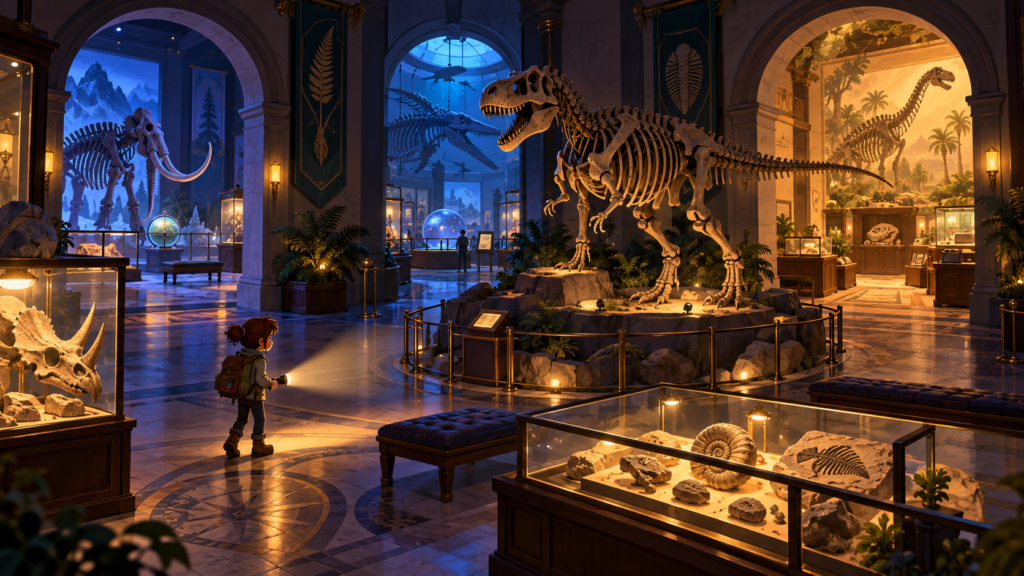
The page image is an original concept view of a nighttime fossil gallery. Treat it as mood reference while making the actual game art. If the implementation uses simpler graphics, keep the clue text, room layout and accessibility more important than matching every visual detail. A short finished game is better than three attractive rooms with broken logic.
Browse more original ideas in the AI Craft Pad prompt library. For accessible game controls, see the W3C ARIA Authoring Practices.