

How to Write Better AI Prompts: A Practical Guide for Beginners
Learn how to write better AI prompts with clear instructions, useful context and practical examples. A beginner-friendly guide to getting more accurate and useful results from AI.
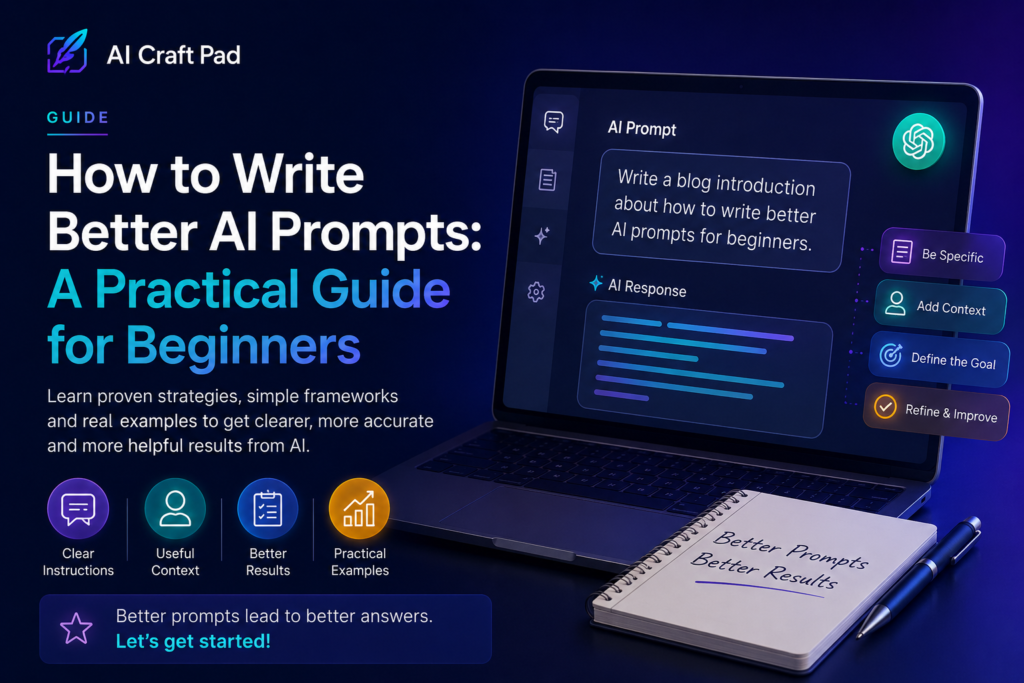
Learning how to write better AI prompts is one of the simplest ways to improve the quality of the answers you get from tools such as ChatGPT and other AI assistants.
A vague instruction often produces a vague answer. A clear prompt gives the AI a better understanding of your goal, context, constraints and the type of result you actually want.
This beginner-friendly guide explains the core principles behind useful prompting and shows how to turn simple requests into instructions that produce clearer, more relevant and more practical results.
Better prompts start with clearer thinking
You do not need complicated prompt-engineering jargon to get better AI results. In most everyday situations, the biggest improvement comes from clearly explaining what you need, why you need it and what a successful answer should look like.
The 6 building blocks of a better AI prompt
Most strong prompts contain some combination of the following elements. You do not always need all six, but they provide a useful framework when your request is important or complex.
Weak prompt vs better prompt
The difference between a weak and strong prompt is often not length. It is the amount of useful direction the prompt gives.
Weak prompt
Write an email to a client.
Better prompt
Write a professional but friendly email to a client explaining that a project will be delayed by three business days. Keep the message clear, concise and reassuring. Do not blame any individual. Include the new expected delivery date and offer to answer questions.
The second version gives the AI the purpose, tone, situation, important details and boundaries. That makes it much more likely to produce a useful first draft.
How to write better AI prompts step by step
A simple prompt formula you can reuse
For many everyday tasks, this structure is enough to create a strong starting prompt.
Task: Help me [specific objective].
Context: Here is the information you need: [context].
Requirements: The result should [requirements].
Constraints: Do not [important limitations].
Output: Return the result as [format].
Common AI prompting mistakes
- Being too vague. “Make this better” does not explain what better means.
- Giving conflicting instructions. Asking for something “very detailed” and “extremely short” at the same time can create weak compromises.
- Expecting AI to know missing context. If the answer depends on information the AI does not have, provide it.
- Asking the AI to invent facts. For factual tasks, tell it not to create missing data, claims or sources.
- Overloading the prompt. More instructions are not always better. Remove anything that does not affect the result.
- Trusting the first answer automatically. Important results should still be reviewed and verified.
💡 Pro Tip
When the task is complicated, ask the AI to first explain its proposed approach or create an outline before generating the full result. This gives you a chance to correct the direction early instead of editing a long answer afterward.
Practical examples of better AI prompts
Write a concise professional follow-up email to a potential client who has not replied for one week. Keep the tone polite and confident, remind them of the proposal and end with a simple next-step question.
Summarize the following report into five key points. Preserve important facts, numbers and conclusions. Clearly note any uncertainty or limitations mentioned in the original text.
Create a practical three-day plan for organizing a small home office. Prioritize low-cost changes first. Separate the plan into tasks, supplies needed and estimated time.
Create a blog post outline for beginners about choosing a laptop for remote work. Organize it with logical H2 and H3 headings, cover the major buying factors and avoid unnecessary keyword repetition.
When should a prompt be more detailed?
Short prompts are perfectly useful for simple tasks. You do not need a large template every time you ask AI a question.
More detail becomes useful when the task has several possible interpretations, important constraints, a specific audience, factual risks or a required output format.
For example, “summarize this paragraph” may be enough for casual use. A business report may require additional instructions to preserve key figures, separate facts from opinions and identify action items.
Good prompting is often iterative
A prompt does not have to be perfect before you send it. One of the most useful ways to work with AI is to improve the request after seeing the first response.
You can say things such as:
- Make the explanation simpler.
- Give me three more practical examples.
- Keep the facts unchanged but make the tone friendlier.
- Turn this into a checklist.
- Remove repetitive sections.
- Explain what information is missing before answering.
These follow-up instructions are also prompts. Effective AI use is often a conversation rather than a single command.
If you want to explore prompting in more depth, you can also read the official OpenAI prompt engineering guide for additional techniques and examples.
Try these practical prompts
If you want ready-to-use examples, these AI Craft Pad prompts apply the principles from this guide to common tasks.
Frequently Asked Questions
Do longer prompts always produce better results?
No. The goal is useful detail, not maximum length. A short, precise prompt can be better than a long prompt filled with unnecessary instructions.
Do I need to use a special prompt framework?
No. Frameworks can help you remember important elements, but clear communication matters more than following a rigid template.
Should I always tell AI to act as an expert?
Not always. A role can help set perspective and style, but it does not guarantee factual expertise. Important claims should still be checked.
Can AI prompts prevent hallucinations completely?
No. Good instructions can reduce unnecessary invention, but they cannot guarantee perfect factual accuracy. Verify important information independently.
Can I reuse the same prompt?
Yes. Good prompt templates are useful for recurring tasks, especially when you replace placeholders with the correct context each time.
Best practices for consistently better AI results
Keep your objective clear, provide the context that genuinely matters and specify important limits. If factual accuracy matters, tell the AI not to guess or invent missing information.
For writing tasks, describe the audience and tone. For research or analysis, explain what evidence matters and what kind of conclusions you need. For planning tasks, define practical constraints such as budget, time or available resources.
Most importantly, review the result. AI can help you think, organize, draft and revise much faster, but good judgment still matters.
Summary
Learning how to write better AI prompts does not require complicated techniques. Start by clearly defining the task, adding useful context, setting important boundaries and requesting the output format you need.
Better prompts reduce ambiguity. They help AI understand what success looks like and make it easier for you to review, refine and use the result.
Think of prompting as clear communication: explain the goal, provide the right information and improve the instructions when the first answer does not fully meet your needs.
Ready to put better prompting into practice?
Explore the AI Craft Pad prompt library for practical, ready-to-use prompts built around real tasks.
Browse Prompts →