

How to Use AI for Competitor Research: A Practical 6-Step Workflow
Learn how to use AI for competitor research with a practical six-step workflow for collecting sources, comparing evidence, identifying gaps, and verifying conclusions.
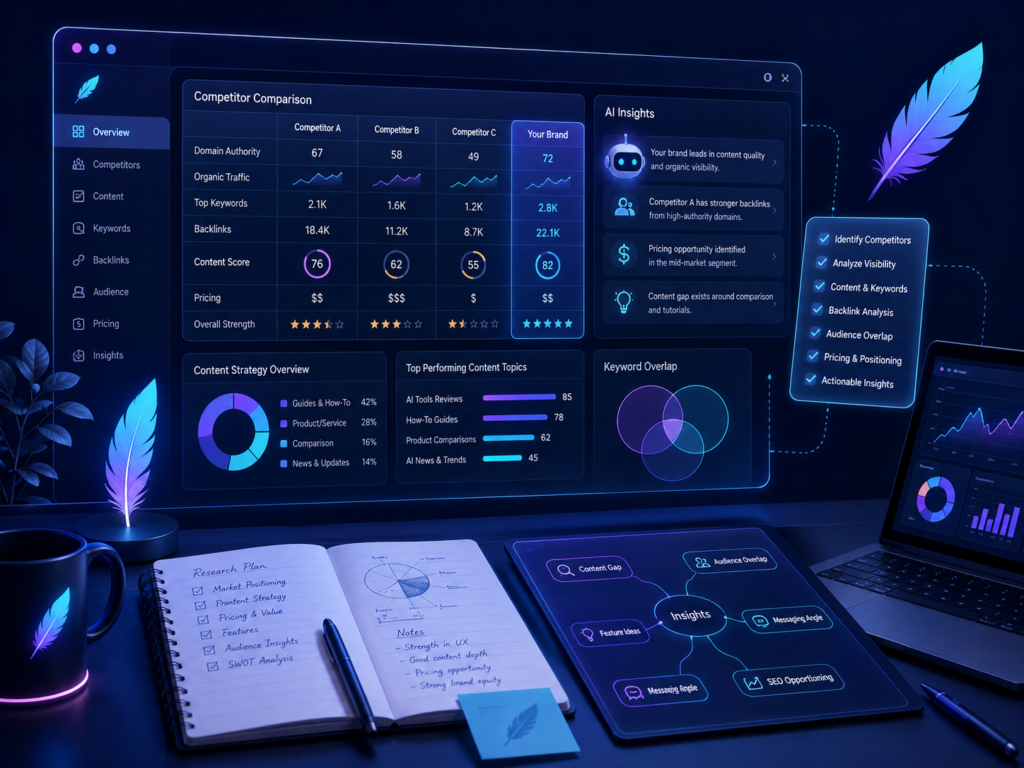
Quick answer: AI competitor research works best when you use AI to organize evidence, compare consistent fields, identify gaps, and generate questions for verification. It should not be treated as the source of truth. The strongest workflow starts with primary sources, gives AI a defined comparison framework, and verifies every important conclusion before it affects a business decision.
Why competitor research often goes wrong with AI
Competitor research looks like an ideal AI task: there are websites to summarize, features to compare, reviews to scan, and positioning to interpret. The problem is that a polished answer can hide weak evidence. A model may combine old pricing with new product details, treat an opinion as a fact, or confidently fill a gap that the source material never answered.
The solution is not to avoid AI. It is to give AI a narrower job. Let it structure, compare, summarize, and challenge your research while you control the evidence.
Step 1: Define the decision before collecting information
Start by asking what you actually need to decide. A broad request such as “analyze our competitors” usually produces broad output. A better research question is specific:
- Which competitor is strongest for small teams?
- How do three products package their paid features?
- What claims are competitors using to position AI automation?
- Where are customers repeatedly reporting friction?
Your decision determines which evidence matters. If the goal is pricing strategy, collect pricing and packaging. If the goal is content strategy, collect positioning pages, documentation, comparison pages, and recurring customer questions.
Step 2: Start with primary sources
Build the first layer of research from the competitor itself: official product pages, pricing pages, documentation, release notes, help centers, terms, and public company announcements. These sources are not automatically unbiased, but they are usually the best place to verify what the company currently claims to offer.
Record the source URL and the date you checked it. Competitor research becomes much easier to maintain when every important fact has a traceable origin.
Step 3: Give AI a fixed comparison framework
Do not ask the model to decide what is important on its own. Use the same fields for every competitor. A practical framework can include:
- target customer;
- core offer;
- key features;
- pricing and packaging;
- positioning and messaging;
- proof points;
- strengths;
- weaknesses or missing capabilities;
- customer friction;
- open questions.
Consistent fields make comparisons useful. They also make unsupported statements easier to notice.
Step 4: Separate facts, inference, and recommendations
This is one of the most useful controls you can add. Ask AI to label statements as one of three types:
- Verified fact: directly supported by the material you supplied.
- Inference: a reasonable interpretation that still needs confirmation.
- Recommendation: an action your business may consider based on the evidence.
Without this separation, a plausible interpretation can gradually turn into a “fact” as the research is reused in presentations, briefs, and strategy documents.
Step 5: Add secondary evidence selectively
Once the basic competitor profile is verified, add customer reviews, independent comparisons, interviews, community discussions, or reputable industry reporting. Do not dump hundreds of comments into the process simply because AI can summarize them. Select evidence that answers a defined question.
For example, if the official site claims an easy setup process, reviews can help test whether customers describe onboarding the same way. If the official pricing page is clear, third-party summaries should not replace it.
Step 6: Turn the output into questions, not just conclusions
A good AI research output should expose uncertainty. Finish every analysis with a verification list: missing prices, unclear feature limits, contradictory claims, outdated screenshots, geographic restrictions, plan differences, or customer segments that are not clearly documented.
This makes the next research pass faster and prevents false confidence.
A simple repeatable workflow
- Define one business decision.
- Collect primary-source evidence.
- Normalize each competitor into the same comparison fields.
- Use AI to summarize and identify patterns.
- Add targeted secondary evidence.
- Verify important claims and list unresolved questions.
Use the ready-made prompt
To run this workflow faster, use the AI Competitor Research Summary Prompt. It includes explicit instructions to mark unknown details, separate inference from evidence, and finish with practical differentiation opportunities.
What to avoid
Avoid asking AI for live competitor facts without providing sources, mixing research collected months apart without dates, treating traffic estimates as confirmed business performance, or copying a competitor’s positioning directly into your own strategy. AI should reduce the mechanical work of research, not remove the verification step.
Final takeaway
The best competitor research workflow is not “ask AI who is better.” It is a controlled process in which AI helps you transform evidence into a consistent comparison. When sources, dates, uncertainty, and verification remain visible, the output becomes useful enough to support real product, marketing, and business decisions.