

AI Prompt for Preparing a Sales Discovery Call Brief
Prepare a concise sales discovery brief from verified prospect information, known account context, hypotheses, and questions without inventing company facts.
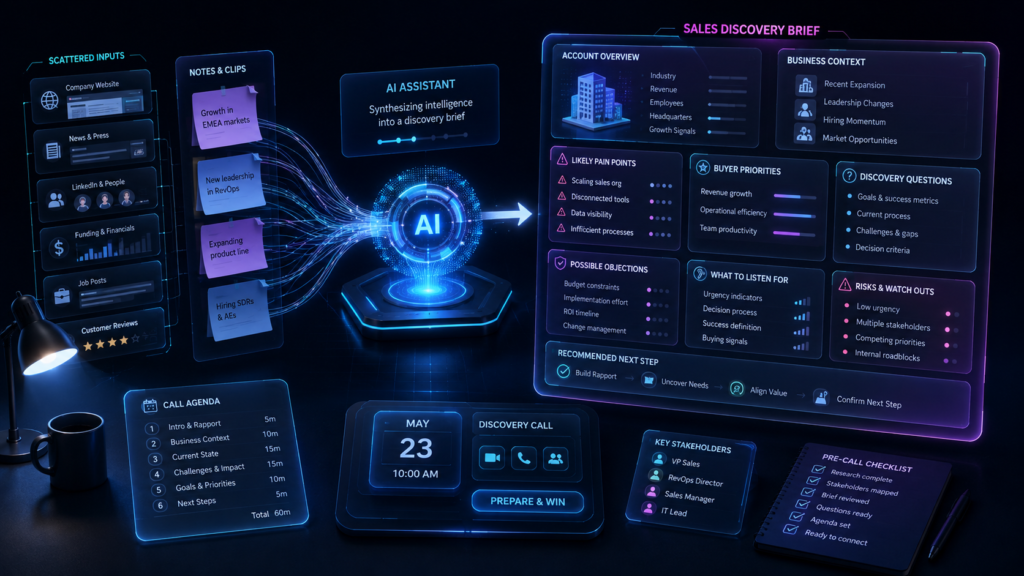
Prepare a concise sales discovery brief from verified prospect information, known account context, hypotheses, and questions without inventing company facts.
AI Prompt for Preparing a Sales Discovery Call Brief
CONTEXT
Prospect; contact role; our offer; verified company information; previous interactions; known goals
TASK
Prepare a short briefing that helps a seller ask better questions without presenting unverified assumptions as facts.
RETURN THESE SECTIONS
- Account snapshot
- Contact context
- Why the conversation may matter
- Hypotheses to test
- Discovery questions
- Follow-up probes
- Possible objections
- Information gaps
- Desired next step
RULES
- Do not invent revenue, budget, tech stack, headcount, pain points, or buying intent.
- Distinguish public facts from hypotheses.
- Avoid sensitive personal information.
How to use it
- Collect only relevant verified information.
- Use hypotheses as questions, not claims.
- Replace hypotheses with confirmed facts after the call.
Best for
B2B discovery, account planning, solution consulting, and partnership conversations.
Worked example: turn known facts into better questions
Fictional source note: The operations lead at Apex Studio asked for a discovery call about coordinating client projects. Your product offers task ownership and deadline tracking. You have no confirmed information about Apex Studio’s budget, current software, or decision process.
Account snapshot — verified: The contact requested a call about project coordination. Your offer includes task ownership and deadline tracking.
Hypotheses to test: Handoffs or missed deadlines may be a problem, but neither is confirmed.
Discovery questions: How do client projects move between teammates today? Where does work most often get delayed? What would a better process change for your team? Who else would help evaluate a new approach?
Information gaps: Current system, decision criteria, timeline, budget, and security requirements.
Desired next step: After the call, send a recap of confirmed needs and agree on the next action with the contact.
Use this structure to keep facts and guesses apart. A specific question is more useful than a polished but unsupported “account insight.”
Review the brief before the call
- Trace every company fact to the supplied notes or a current source; remove anything you cannot verify.
- Turn suspected pain points into neutral questions. Avoid questions that assume a problem or push the prospect toward your solution.
- Choose five to seven core questions that fit the time available. Keep optional probes separate.
- Check whether personal or confidential details are necessary. Exclude them from the AI input unless your process permits their use.
- After the call, update the brief with what the prospect actually said and confirm any commitments before they enter the CRM.
Related steps
For question design, use How to Prepare Customer Interviews With AI. After the conversation, draft a specific, respectful next message with the follow-up email prompt. For a repeatable process that turns raw feedback into themes, see the Customer Feedback Analyzer workflow.