

AI Prompt for Creating a Job Interview Scorecard
Create a structured interview scorecard from a real job description, must-have competencies, and role outcomes to make candidate evaluation more consistent.
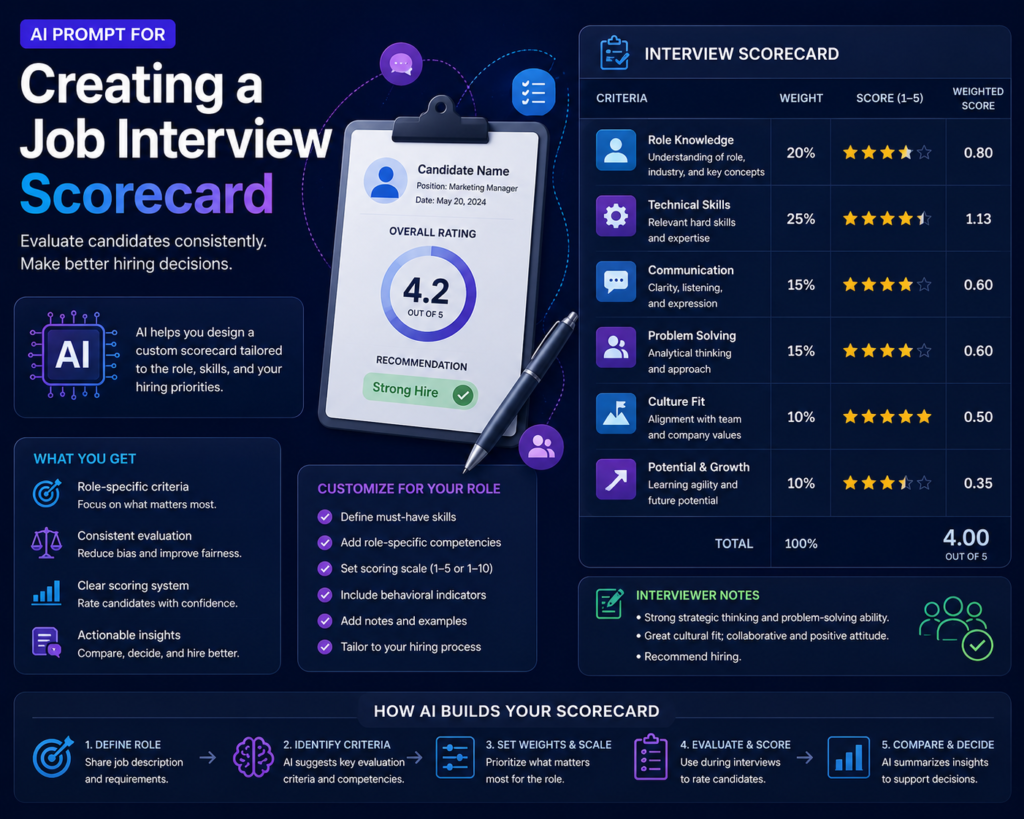
Create a structured interview scorecard from a real job description, must-have competencies, and role outcomes to make candidate evaluation more consistent.
AI Prompt for Creating a Job Interview Scorecard
CONTEXT
Role title; job description; first-year outcomes; must-have competencies; nice-to-haves; interview stages
TASK
Build a consistent scorecard focused on job-relevant evidence.
RETURN THESE SECTIONS
- Role outcomes
- Core competencies
- Behavioral questions
- Follow-up probes
- Scoring anchors 1/3/5
- Job-relevant red flags
- Evidence summary template
- Debrief questions
RULES
- Do not include protected characteristics or proxies.
- Do not score appearance, accent, family status, or cultural similarity.
- Tie scores to observable evidence.
How to use it
- Start with finalized role outcomes.
- Use the same core scorecard for candidates in the same process.
- Have HR or the hiring owner review it.
Best for
Hiring teams, interview panels, recruiting operations, and structured evaluation.
job interview scorecard works best when the AI receives real source material, a clear goal, and explicit constraints. Create a structured interview scorecard from a real job description, must-have competencies, and role outcomes to make candidate evaluation more consistent. The purpose is not to make the output sound impressive; it is to make the result easier to verify, edit, and use in real work. Tie every criterion to the actual role and observable evidence rather than vague impressions.
How to use this job interview scorecard
Start with the original information rather than a cleaned-up summary. Tell the AI who will use the result, what decision or action the output should support, and which facts must remain unchanged. Add relevant deadlines, terminology, required sections, and any rules that limit what the AI may infer.
- Gather the source notes, data, documents, or observations in one place.
- State the goal and audience before pasting the source material.
- Run the prompt once without asking the AI to fill missing facts.
- Review uncertain statements, calculations, names, dates, owners, and claims against the source.
- Revise the final output for clarity and remove anything that cannot be supported.
job interview scorecard: what to check before you trust the output
Use the same core scorecard for comparable candidates and remove protected characteristics or proxies. AI can organize and synthesize information quickly, but a polished answer is not evidence by itself. Important facts should remain traceable to the material you supplied.
- Accuracy: can every important claim be checked against the source?
- Completeness: are missing inputs clearly marked instead of silently invented?
- Relevance: does each section help the intended reader make a decision or take action?
- Clarity: are facts, assumptions, recommendations, and open questions easy to distinguish?
- Safety: have sensitive, legal, financial, personal, or confidential details been handled appropriately?
Common mistakes to avoid
A common failure is giving AI too little context and then accepting confident filler as if it were verified. Another is asking for a final answer before defining the required format. Avoid vague instructions such as “make this better” when the real need is to summarize, compare, classify, prioritize, or draft a specific deliverable. Do not add invented statistics or examples simply to make the output look complete.
A practical review workflow
Use the first AI output as a working draft. Compare it line by line with the most important source material, resolve unsupported statements, and then ask for a focused revision. For recurring work, save the final instructions and review checklist so the next run starts from a proven process rather than from scratch. This creates consistency without removing human accountability.
When this prompt is most useful
AI Prompt for Creating a Job Interview Scorecard is most valuable when the task is repeated, the source material is messy, or several people need the output in a consistent structure. It is less useful when the required facts are unavailable, when a qualified professional must make the final judgment, or when the task depends on information the AI has not been given.
Related AI Craft Pad resources
Continue with more practical AI prompts or use a step-by-step AI guide when the task needs a repeatable process.