Why AI Lettering Needs a Human Typography Pass
Image models can explore ink rhythm; final words need deliberate lettering.
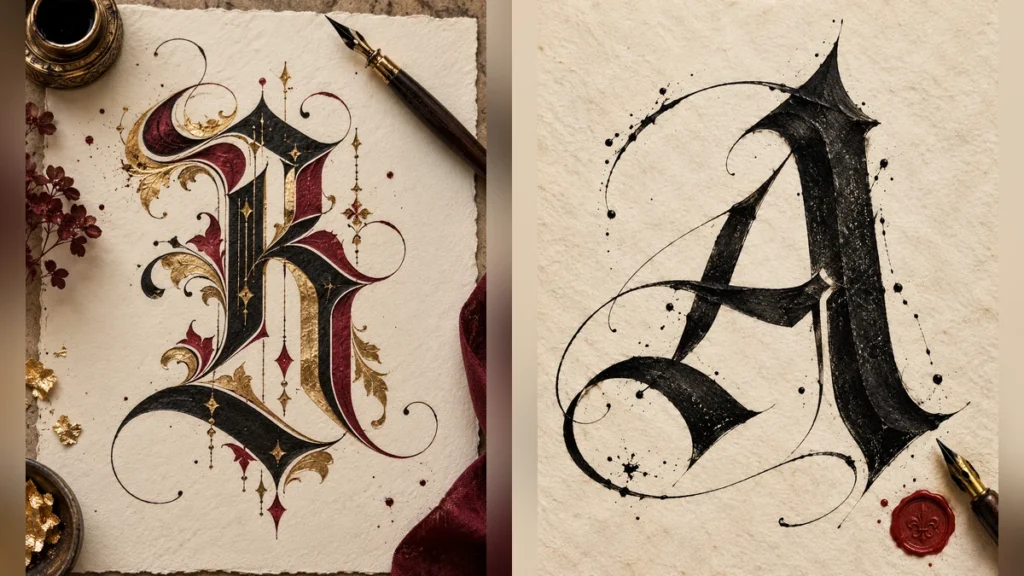
An AI calligraphy prompt can quickly explore blackletter rhythm, swashes, ink texture, and dramatic composition. It is a poor final proof for exact spelling. A striking image with an unreadable word is still unusable as a title.
Separate concept from final lettering
Prompt for paper grain, nib contrast, stroke energy, flourish placement, and negative space. Decide whether the composition needs one ornate initial or a whole wordmark. Treat generated marks as a mood study, not a finished font file. A prompt cannot guarantee a complete alphabet, consistent kerning, or licensed typeface.
Build an editable master
Choose a suitable licensed blackletter or draw the letters as vector shapes. Set the exact words, then refine spacing, stroke joins, baselines, and swash intersections by hand. Keep a plain, unornamented version beside the decorated one to confirm readability. Use ink splatter only where it does not obscure glyphs.
Proof at real size
Check every letter against the requested text, including repeated letters and punctuation. Reduce the design to thumbnail size and verify that the word still reads. Export an editable source and a high-resolution image. A collage may show several letterform directions, but provide large individual examples so buyers can inspect line quality and structure.