

Top-Down Battle Map Prompts: Layout Before Decoration
Tactical maps work when players can read movement before admiring texture.
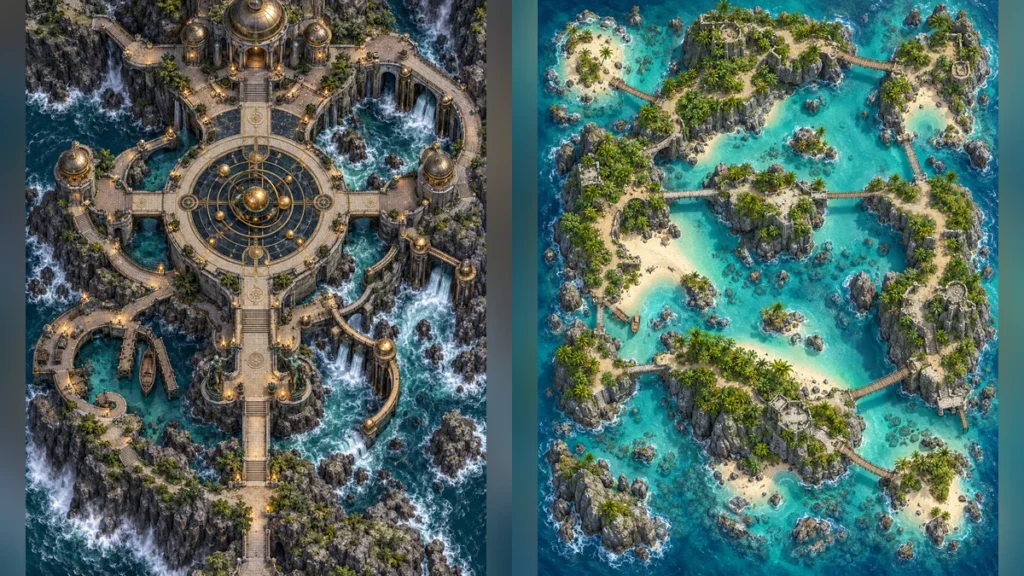
An AI battle map prompt should begin like a level-design brief. A dramatic illustration may look impressive yet fail at the table if it has unclear entrances, obstructed squares, or an accidental perspective tilt.
Specify the camera and boundary
Ask for a strict orthographic bird’s-eye view with no horizon. Define the playable floor and the outer boundary, then state the output ratio. For a room map, name each door, stair, obstacle, and open fighting area. For an outdoor crossing, mark both approaches and the routes between them. Ask for the whole useful play area to remain inside the image.
Give terrain a function
Every major feature should change a decision. A ruined pillar can provide cover, a raised walkway can offer risk and advantage, and shallow water can slow movement. Decorative rubble should not hide where a token can stand. Keep floor texture less busy than walls or scenery. If a grid is needed, add a precise grid in a separate layout step rather than trusting irregular image-generated lines.
Test at playing size
Reduce the map to its expected tabletop or screen display size. Trace a route from every entrance to the main area. Check for impossible stairs, sealed exits, ambiguous elevation, and objects that look passable in one place but solid elsewhere. Then inspect the full-size original for repeated stones, broken geometry, and stray marks. The small collage can sell the atmosphere; a separate full-size map proves usability.