

Why AI Images Look Artificial—and How to Fix the Most Common Problems
Learn how to Why AI Images Look Artificial—and How to Fix the Most Common Problems with a practical AI-assisted workflow, clear steps, examples, quality…
fix artificial looking AI images is the central practical topic of this guide. The workflow below treats AI image production as a sequence of decisions—brief, generation, review, revision, and final-use checks—so quality depends on clear criteria rather than on accepting the first polished result.
fix artificial looking AI images: practical decision criteria
Before choosing a model or writing a long prompt, define what must remain accurate, what may vary creatively, and how the final image will be judged. For business use, keep a short record of the source brief, references, model settings, major revisions, and final approval. This makes the process easier to repeat and easier to audit when an image is used in a campaign, publication, product page, or client deliverable.
Why AI Images Look Artificial—and How to Fix the Most Common Problems is a practical production problem, not a matter of finding one magical prompt. The reliable approach is to define what must stay stable, decide what may vary, generate deliberately, and review the result against the brief before it reaches a public channel.
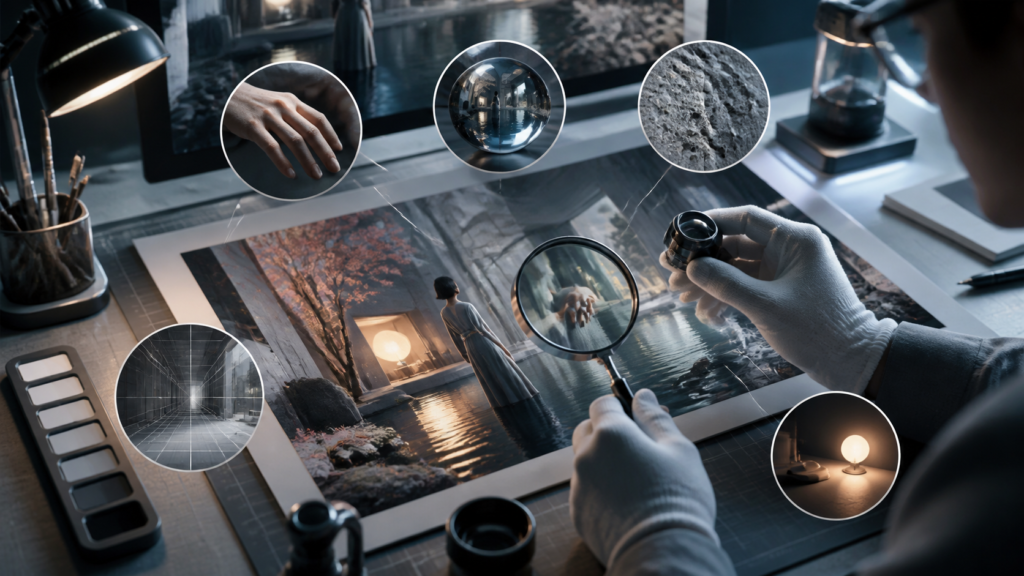
This guide focuses on image quality control. The core working areas are anatomy, perspective, reflections, material response, lighting, edge behavior, and over-stylization. Each can be reviewed separately, which makes revision faster and reduces the temptation to rewrite the entire prompt after every imperfect output.
Start with the production decision, not the prompt
Before writing for an image model, write a one-sentence production decision: what the image is for, who will see it, and what it must communicate. A social image, concept render, product campaign visual, character sheet, and storyboard frame can all look polished, but they succeed by different criteria. If the final use is unclear, prompts tend to accumulate style adjectives instead of solving a communication problem.
List the stable facts first. These may include subject identity, product geometry, room openings, screen direction, approved palette, or a reserved text zone. Styling choices such as haze, color grade, surface treatment, or illustration texture come after those anchors. This order matters because a visually dramatic image with the wrong structure is expensive to rescue.
Build a compact reference brief
A strong reference brief can fit on one screen. List the subject, output format, aspect ratio, required details, forbidden changes, camera or viewpoint, lighting logic, palette, and downstream editing needs. If you have authorized reference images, note what each reference is for instead of asking the model to copy a style. One image may document geometry, another palette, and another composition.
Use concrete language. “Keep the two window openings and ceiling height unchanged” is more useful than “faithful redesign.” “Same jacket, hair silhouette, eye color, and shoulder proportions in every frame” is more useful than “consistent character.” Concrete invariants are easier to verify after generation.
Separate fixed elements from controlled variables
Create two lists. The fixed list contains details that should survive every generation. The variable list contains elements you are willing to explore. This prevents each revision from becoming a complete reset.
- Fixed: identity, geometry, spatial layout, approved product features, key palette rules, or continuity facts.
- Controlled variables: camera distance, secondary prop, weather, background treatment, light softness, or illustration texture.
- Free variables: low-risk details that can vary without changing the meaning of the image.
When a fixed element keeps drifting, reduce the number of free variables and move the invariant earlier in the prompt. If the tool supports references, masks, or editing, use those controls rather than trying to solve every continuity problem with prose alone.
Use prompt hierarchy
A production prompt should read in the same order a creative lead would give instructions: subject and task first, then composition, viewpoint, light, materials, environment, finish, and constraints. This hierarchy matters because many visual instructions compete for attention. The more unrelated adjectives you add, the easier it is for structural requirements to lose priority.
Keep style language descriptive rather than imitative. Describe photographic behavior, rendering medium, paper texture, lens characteristics, or color relationships. Avoid requests to mimic a living artist or reproduce a recognizable protected character. Precise visual properties are more controllable and easier to adapt to your own brand.
Run exploration and refinement as different phases
Exploration is for finding a direction. Refinement is for protecting a direction while fixing defects. Treating every generation as exploration wastes good structure; treating the first output as final encourages unnoticed errors.
- Generate a small exploratory set with the same fixed brief.
- Choose the frame with the strongest composition and structural fidelity, not simply the most dramatic styling.
- Write down what is already correct.
- Change one major variable for the next pass.
- After the direction is stable, move to detailed quality control and local edits.
This also makes review easier. A reviewer can say “keep frame three, reduce the rim light, and restore the original cap” instead of restarting the entire brief.
Evaluate with decision criteria
Do not judge only by whether an image feels impressive. Review criteria must connect to the intended use.
- Brief fidelity: does the image communicate the intended subject and purpose?
- Structural consistency: are geometry, identity, spatial relationships, and proportions stable?
- Physical coherence: do light, shadows, reflections, materials, and perspective agree?
- Visual hierarchy: is the focal point obvious, with supporting detail secondary?
- Production usability: are crop, negative space, resolution, and layout suitable for the destination?
- Rights and truthfulness: does the image avoid unauthorized likenesses, copied assets, invented claims, or misleading details?
A practical revision example
Begin by documenting what cannot change. Then choose one output objective and one visual treatment. If the first set has attractive lighting but broken structure, do not polish it further; fix structure first. If structure is strong but the image feels flat, adjust lighting, camera separation, or palette.
If a revision improves atmosphere but introduces an extra object or changes a key feature, preserve the previous successful frame and use an editing or inpainting step when available. Global generation is best for exploration; targeted editing is usually better for correction because it protects the parts that already work.
Know the limitations
Generated images are useful for ideation, mood, presentation, and controlled creative production, but they are not evidence that a physical object, building, person, product feature, or event exists as shown. Fine text, exact diagrams, repeated geometry, and multi-view continuity may drift. A model can produce a plausible image without understanding engineering tolerances, legal claims, package specifications, or real-world performance.
Do not use generated visuals as a substitute for measurements, construction documents, medical or legal evidence, product certification, or factual reporting. Wherever an image implies a claim about reality, verify that claim with the appropriate source outside the generation workflow.
Common failure modes
Too many objectives in one frame
Split the brief. One hero image should usually carry one primary message. Secondary details can support it, but they should not compete with it.
Style is stronger than structure
Move geometry, identity, continuity, or product constraints earlier and reduce mood adjectives. A restrained image with correct structure is easier to finish than a spectacular image with the wrong subject.
Uncontrolled iteration
Save selected generations and record prompt changes. If every pass changes five variables, you cannot tell which decision improved the result.
Hidden factual claims
Check whether the image implies a feature, location, statistic, interface, certification, or event that was never verified. Remove or replace those elements before publication.
Practical workflow
- Write the one-sentence production objective.
- List fixed elements, controlled variables, and forbidden changes.
- Choose output ratio and downstream layout needs.
- Write the prompt in subject → composition → viewpoint → light → materials → environment → constraints order.
- Generate a small exploratory set.
- Select for structure and brief fidelity.
- Refine one major variable at a time.
- Inspect at full size for anatomy, perspective, reflections, materials, repeated objects, and unintended text.
- Verify rights, likeness, brand assets, and any implied factual claim.
- Export the final asset and keep the source prompt, references, and approval notes with the project.
Final checklist
- The image has one clear purpose and audience.
- All non-negotiable details match the brief.
- Composition and crop work for the destination.
- Lighting and material behavior are coherent.
- No accidental text, logo, watermark, or protected character appears.
- No product feature, statistic, event, or real-world fact is invented.
- Authorized references are used only for their intended purpose.
- The asset has been reviewed at full resolution, not only as a thumbnail.
- Downstream typography and branding are added with approved design assets.
- The final export and source prompt are archived for future revisions.
Related AI Craft Pad prompts
Create a Magazine-Style Editorial Portrait, Create a Luxury Product Hero Shot, Create a Warm Minimalist Interior With Real Materials. Each keeps the production requirement explicit instead of relying on uncontrolled style guessing.
Summary
Why AI Images Look Artificial—and How to Fix the Most Common Problems becomes more manageable when the work is treated as a production system. Define the purpose, lock what must stay stable, explore only variables that are safe to change, and evaluate the output with criteria tied to the final use. Human review remains essential because visual plausibility is not the same as factual or production accuracy.